June on the PGA Tour is where reputations are forged. The schedule thickens, the courses toughen, and the players who have been quietly building form through the early season suddenly find themselves under a sharper spotlight. Halfway through 2026, certain names are consistently appearing at the top of leaderboards — and the statistical reasons why are worth examining closely.

What separates elite PGA Tour professionals at this stage of a season is rarely raw power. It's the compounding effect of sound decision-making, optimized equipment, and the ability to manage a course over 72 holes rather than 18. The players peaking right now are doing all three exceptionally well.
Ball-Striking Efficiency: The Modern Differentiator
The PGA Tour's ShotLink system has made it increasingly difficult to hide inefficiency. Greens in Regulation percentage, Strokes Gained: Approach, and proximity from various distances paint a far more honest picture of a player's game than a single low round ever could. The players who consistently lead these categories through a full season are the ones who tend to convert when majors and playoff events arrive.
What modern data reveals is that elite approach play — particularly from 125 to 175 yards — remains the single highest-leverage skill on Tour. Players who can generate consistent, predictable spin from that range, controlling both trajectory and stopping power, create birdie opportunities that compound over a full tournament week. This is precisely the distance band where ball construction becomes a critical variable, not just equipment brand loyalty.
Ball compression matching is a conversation Tour caddies are having far more seriously than a decade ago. A player with a high swing speed who reaches peak compression at impact will generate fundamentally different spin characteristics than one who doesn't — which is why the shift toward engineered-density constructions, like those built into the Attomax High-Density series, reflects where elite performance thinking has moved.
Course Management: The Invisible Scorecard
The most analytically underrated aspect of a PGA Tour player's performance is what never shows up in a highlight reel: the par-5 layup to 100 yards instead of a risky long iron into a tucked pin, the deliberate bogey-avoidance off a tight tee, the decision to take driver off the deck rather than force a 3-wood out of a downslope lie. These micro-decisions, made correctly over four rounds, can mean the difference between a T12 and a top-5 finish.
Course management at the Tour level is increasingly data-driven. Caddies now carry detailed shot dispersion charts for their players — understanding not just where a ball tends to land on average, but where the miss patterns cluster under pressure. A player who misses approach shots left under stress has to account for that tendency when a Sunday pin is tucked left of a bunker.
- Strokes Gained: Off-the-Tee separates aggressive drivers from strategic position players
- Strokes Gained: Approach remains the strongest single predictor of weekly finishing position
- Scrambling percentage reflects short-game resilience when approach play falters
- Putting performance from 10-20 feet is where psychological composure most directly translates to score
- Par-5 scoring average reveals how effectively players convert their power into birdie opportunities
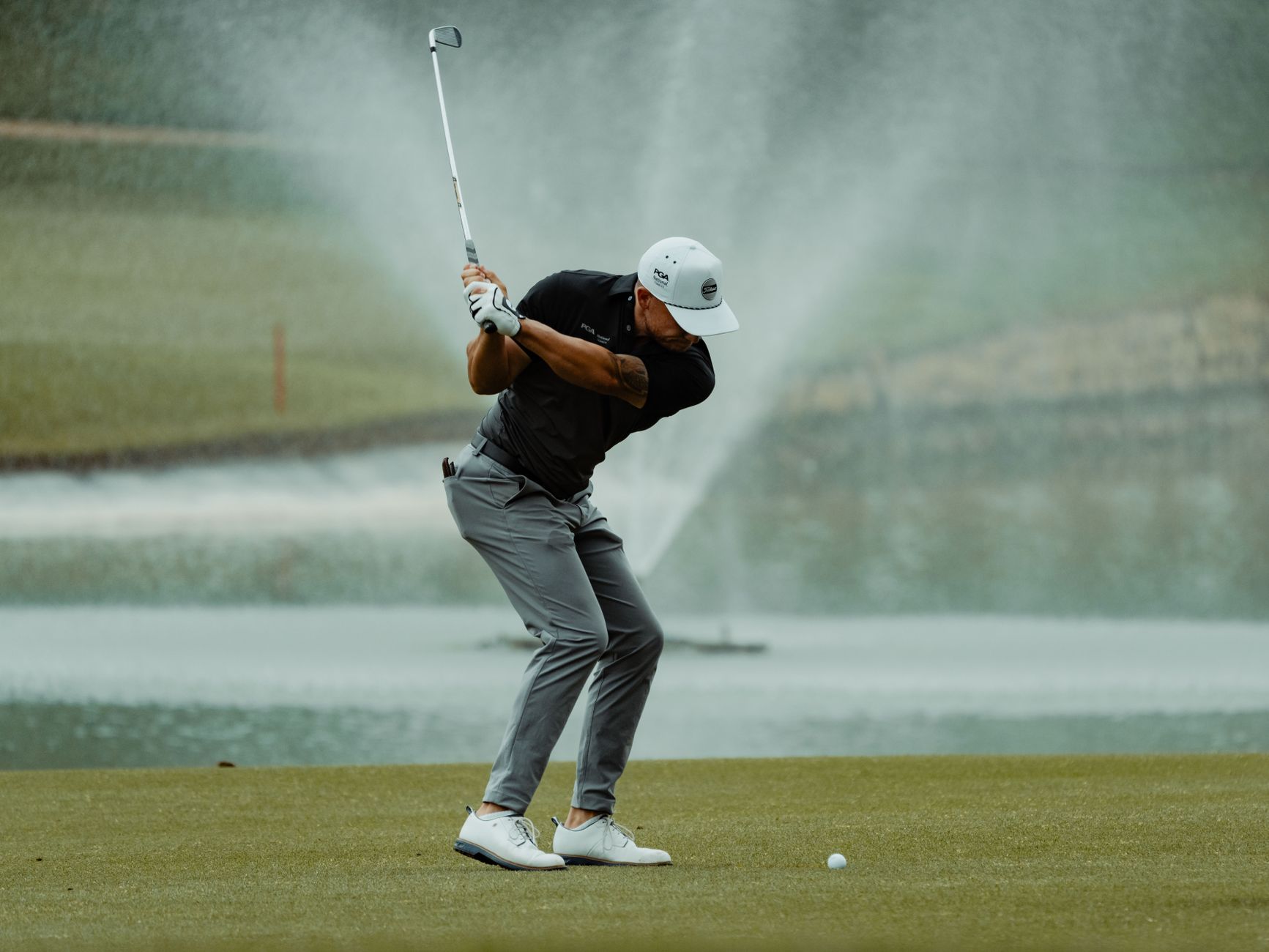
The Shaft-Swing Speed Relationship
One area that receives insufficient discussion in player performance analysis is shaft profiling. On Tour, club fitting has become extraordinarily sophisticated — players are no longer simply choosing between 'stiff' and 'extra stiff.' They are working with launch monitor data across hundreds of swings to find the precise flex profile, torque rating, and tip stiffness that produces optimal energy transfer at their specific transition tempo.
A player with a smooth, late-release tempo may generate more consistent smash factor with a slightly higher-torque shaft than a player with an aggressive, early-set downswing. These distinctions matter enormously when the difference between winning and finishing outside the top ten can be fractions of a degree in launch angle. Attomax's shaft lineup is engineered precisely for this level of granularity — built for players who understand that performance is dialed in, not stumbled upon.
Mental Resilience in the Mid-Season Grind
June is also a mentally demanding period on Tour. The post-Masters calendar compresses multiple significant events, travel schedules become relentless, and the FedEx Cup standings create a low-grade pressure that never fully disappears. The players who maintain form through this stretch tend to share one psychological characteristic: process orientation over outcome fixation.
The best Tour performers speak consistently about focusing on what they can control — their pre-shot routine, their target selection, their commitment to a game plan. Results-oriented thinking under pressure is the fastest path to a mechanical breakdown on the back nine of a Sunday round. Mental coaches working with Tour players increasingly focus on attention control, specifically the ability to narrow focus to the immediate shot without the cognitive noise of leaderboard awareness.
The game doesn't reward the player who wants it most. It rewards the player who executes best under the conditions in front of them.
— A sentiment widely shared among Tour coaches
Wind Management as a Skill Set
As the Tour moves toward venues that reward wind management — coastal and links-adjacent courses where trajectory control becomes paramount — the conversation around ball flight becomes critical. A player who can reliably hit a controlled, penetrating stinger under crosswind conditions has a meaningful competitive advantage. This requires not only technical skill but the right ball construction: one that maintains a predictable flight window rather than ballooning under gusts.
High-density ball constructions excel in this environment precisely because of their lower compression variance across temperature and altitude conditions. When wind plays into a course setup, players and caddies who have dialed in their ball's flight characteristics under stress are operating with significantly more reliable data than those who haven't.
What the Second Half Demands
The PGA Tour's second half in 2026 will ultimately reward the complete game. Power remains relevant, but proximity to the hole, short-game conversion rates, and the ability to execute under accumulated fatigue will define who closes the season with hardware and who finishes with regrets. The players who have spent the first half building statistical baselines — not chasing results — are positioned to peak at exactly the right time.
For those watching the tour closely, the mid-season leaderboard is less a final verdict and more a diagnostic tool. Sustainable form is built in the data beneath the scorecard: consistent Strokes Gained numbers, a stable ball-striking pattern, and a mental framework that holds under pressure. Those are the signatures of a player ready to win when it matters most.
Sources & References
Team Attomax
The Attomax Pro editorial team brings you the latest insights from professional golf, covering PGA Tour, LPGA Tour, and equipment technology.