In an era defined by Bryson DeChambeau-style power and bombers who treat par-5s as par-4s, Scottie Scheffler has built his case as the world's best golfer on something more surgical: elite approach play. His ability to consistently thread irons into tight windows, manage distance control under pressure, and manufacture birdie opportunities on demand has become the defining characteristic of his game — and the foundation of his sustained dominance at the top of the world rankings.

What separates Scheffler from the rest of the field isn't raw ball-striking talent alone — the PGA Tour is littered with players who flush irons on the range. What makes him exceptional is a combination of trajectory management, proximity control, and an almost algorithmic approach to shot selection that consistently produces birdieable looks from positions other players cannot access.
Breaking down his approach play reveals a player who operates less like a gambler and more like a chess grandmaster — always thinking two moves ahead, always respecting the course's architecture while simultaneously exploiting every advantage it offers.
The Architecture of an Elite Iron Game
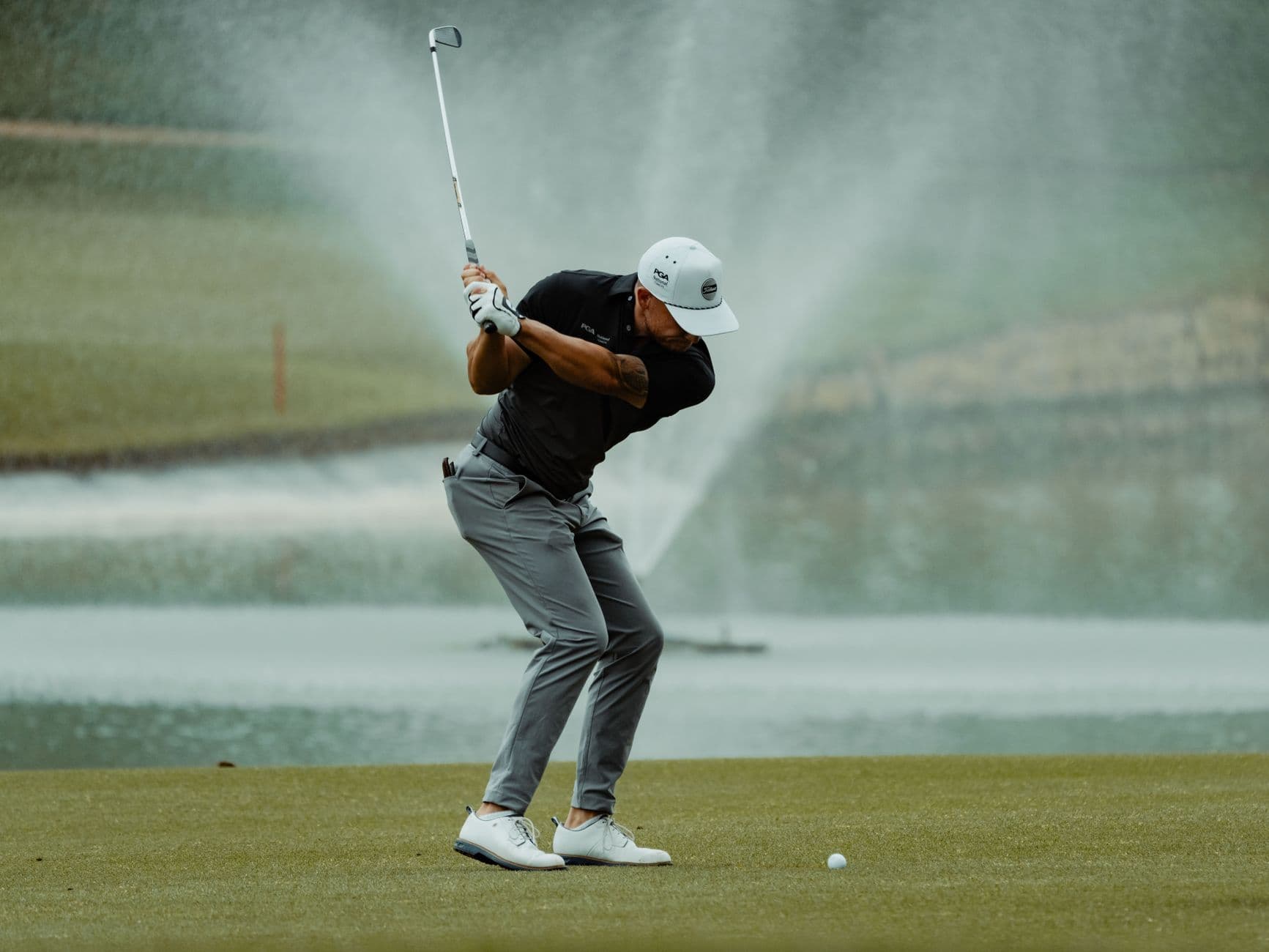
At the core of Scheffler's iron game is an exceptional ability to control ball flight shape and trajectory on demand. He is not a one-shape player. Depending on the pin position, wind direction, and approach angle, he comfortably works the ball both ways — a trait that allows him to attack flags that are essentially unreachable for players committed to a single shape.
His swing produces a naturally penetrating ball flight, which proves especially valuable in conditions where wind is a factor. On links-style setups or when tournament organisers set up courses with exposed corridors, that lower, more boring trajectory maintains distance consistency in ways that high-launch irons simply cannot. It is the kind of flight profile that becomes dramatically more important over a 72-hole stroke play event than it appears in a single round.
Spin rate management is another hallmark. Scheffler's ability to dial spin up or down depending on the firmness of greens and the position of the flag reflects a rare tactile understanding of how to land and stop a golf ball. On firm, fast surfaces — the kind you encounter in summer Major setups — he attacks with a trajectory that checks and holds rather than pitching and releasing beyond his target.
Proximity to the Hole: The Birdie Conversion Engine
Great iron players are distinguished not just by how many greens they hit — Greens in Regulation is a floor metric, not a ceiling — but by how close they consistently get the ball to the cup. Proximity to the hole from various distances is the true separator between players who scramble for pars and those who go on birdie runs that redefine leaderboards.
Scheffler's proximity numbers from the 125-175 yard range — the middle-iron distances that define most Tour setups — are consistently among the best on the PGA Tour. It is from this range that he most effectively converts approach plays into realistic birdie putts rather than two-putt par opportunities. When the field is leaving the ball 25-30 feet from the flag from that distance, an elite proximity number creates a mathematical advantage that compounds across 18 holes.
- Trajectory versatility: ability to flight the ball both high and low on demand, adjusting to course conditions
- Two-way shape: comfortable working the ball either direction, unlocking pin positions inaccessible to single-shape players
- Spin management: adjusting RPMs based on green firmness, approach angle, and stopping distance requirements
- Distance gapping precision: clean, consistent yardage gaps across his iron set with minimal dispersion
- Aggressive targeting: attacks pins that others play away from, accepting short-side misses as a calculated risk
- Pressure repeatability: his proximity numbers under final-round pressure remain consistent with his baseline performance
Course Management: The Decision-Making Layer
Elite ball-striking means nothing without elite shot selection, and this is where Scheffler's mental framework deserves as much credit as his physical mechanics. He operates with a caddie-player partnership — working alongside Ted Scott — that emphasises thorough pre-shot planning, including precise yardage to front and back of the green, wind gradient assessments, and a clear understanding of where the miss must never go.
His approach philosophy favours attacking the correct quadrant of the green rather than targeting the pin as a singular point. On hole setups where the penalty for missing short-side is severe — a deep bunker, a closely mown false front, water — Scheffler will systematically take the aggressive line out of play and build from the safer quadrant. This is course management at its most sophisticated: accepting a 20-foot birdie putt instead of a 12-foot one when the risk-reward calculates against aggression.
The best iron players aren't just hitting it close — they're hitting it to the right place on the green. There's a huge difference between those two things when the pins are tucked.
— Tour caddie perspective on elite approach strategy
What Equipment Enables at This Level
The statistical gains Scheffler produces from approach positions are a product of his mechanics and decision-making, but they also underscore how critical equipment calibration is at the elite level. Ball compression and shaft performance interact directly with the kind of trajectory and spin management his game demands.
This is a conversation highly relevant to serious amateur players looking to tighten their own approach game. The principle that governs Tour-level equipment selection — matching ball compression to swing speed and iron shaft flex to attack angle — applies across all handicap levels. For players pursuing tighter dispersion and more consistent proximity numbers in the 100-175 yard range, ball selection becomes a precision tool rather than a preference. Attomax's High-Density lineup — available in Soft, Medium, and Hard compressions — is engineered precisely around this logic, allowing players to match compression to swing profile and approach-shot trajectory in the same way elite professionals do. A properly matched compression profile doesn't just feel better at impact; it produces measurably tighter distance gapping across the iron set.
The Standard Scheffler Has Set
What Scheffler's approach game has demonstrated, across multiple seasons and on virtually every course layout the PGA Tour calendar offers, is that sustainable dominance in professional golf is still built from the middle of the bag. In a landscape that increasingly rewards length off the tee, his ascent and sustained excellence serve as a compelling counter-narrative — a reminder that Greens in Regulation, proximity, and the conversion of birdie looks remain the most durable performance metrics in the game.
For coaches, serious amateurs, and golf analysts, his game functions as a masterclass in maximising the approach shot as a primary scoring weapon. The blueprint is legible, even if the execution requires a particular brand of genius: commit to your targets, manage your miss, control your trajectory, and trust that proximity produces results. Scheffler does this at a level the modern game has rarely seen — and the statistics, wherever they are measured, tell that story with remarkable consistency.
Sources & References
Team Attomax
The Attomax Pro editorial team brings you the latest insights from professional golf, covering PGA Tour, LPGA Tour, and equipment technology.