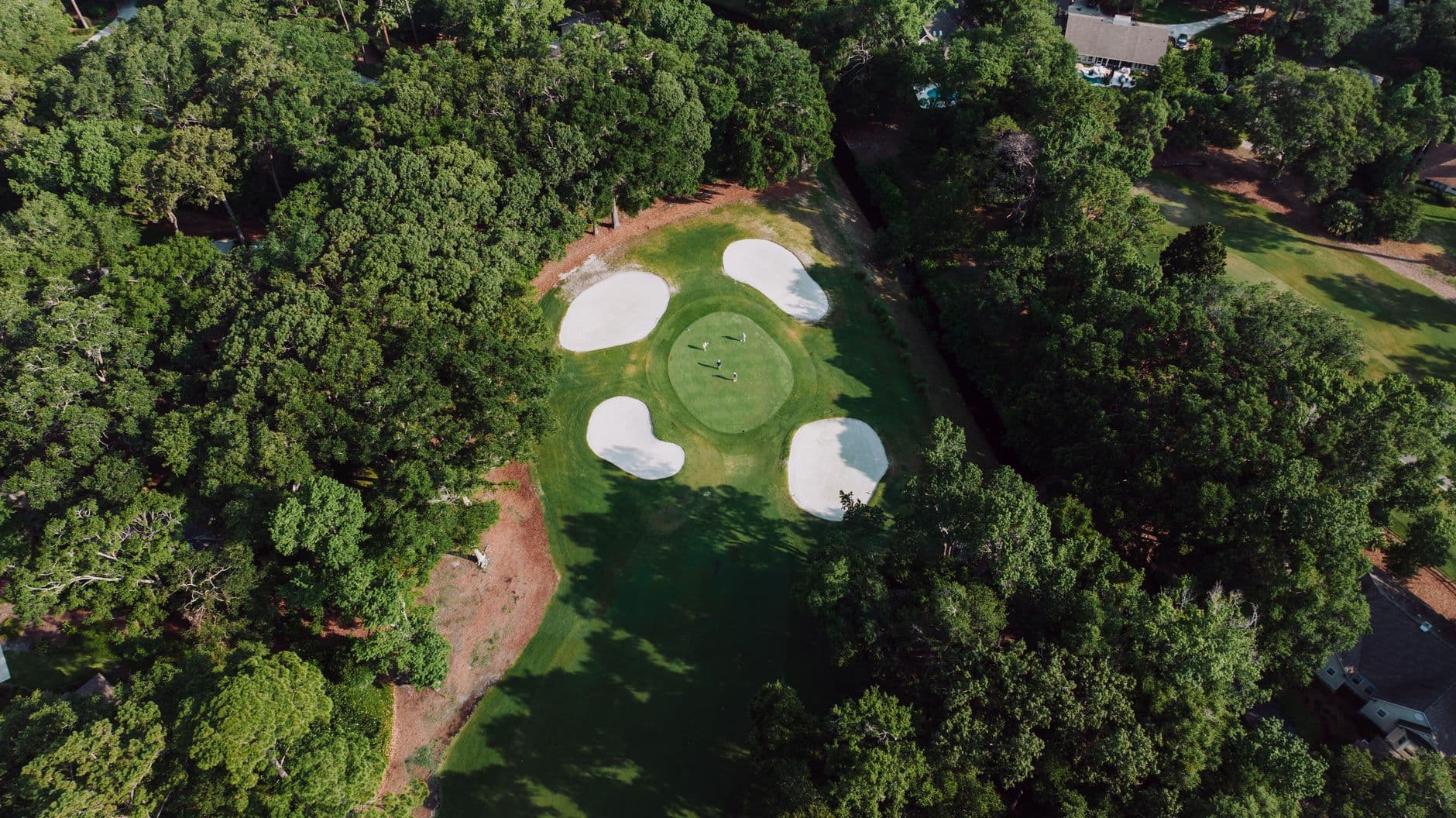
There is no hole in golf quite like the 17th at St Andrews. Known simply as the Road Hole, this 495-yard par-4 on the Old Course has been shaping — and breaking — championship scores for well over a century. It is not merely difficult. It is architecturally brilliant, historically loaded, and psychologically relentless.

Every serious golfer who has walked the Old Course knows the feeling: you step onto the 17th tee with your card in decent shape, and suddenly every decision feels heavier. The Road Hole does not just punish bad shots — it punishes timid thinking, overconfident approaches, and misjudged wind equally.
A Hole Built on Centuries of Drama
The Old Course at St Andrews dates back to the 15th century, making it the spiritual home of the game. The Road Hole has existed in various forms throughout that history, but its modern character — tight, blind, unforgiving — crystallized as tournament golf codified the layout. The R&A has long regarded it as one of the most complete examination holes in existence.
What makes the hole so enduring is its layered complexity. It does not rely on length alone. It demands an informed tee shot, a precise approach calculation, a nervy short game, and a putting surface that reads unlike almost anything else in championship golf — all in sequence, with disaster lurking at every stage.
The Tee Shot: Committing Over the Corner
The drive on the 17th is one of the most awkward in links golf. Players must carry the corner of the Old Course Hotel — specifically, the black shed-like structure on the hotel grounds — to find the fairway. Aim too far left and you're blocked out. Aim too far right and you flirt with the out-of-bounds fence running down the right side of the hole.
In a links wind, this calculation becomes genuinely treacherous. A right-to-left breeze can drag even a well-struck tee ball into trouble, while an into-wind condition compresses the margin for error on the carry. Elite professionals routinely discuss the Road Hole tee shot as one of the few in major championship golf where there is no comfortable line — every option involves accepting some form of risk.
- Aiming over the hotel corner requires a precise carry to avoid the OOB fence right
- A bail-out left leaves a severely angled approach with no clear sight line to the flag
- Wind direction fundamentally alters the optimal tee shot shape and club selection
- Most professionals favor a controlled fade off the tee to maximize fairway access
The Approach: The Road Hole Bunker
If the tee shot is the Road Hole's opening argument, the approach is its verdict. The green is narrow and angled sharply away from the natural line of attack, protected on its left front by the notorious Road Hole Bunker — a deep, steep-faced pot bunker that has ended more championship runs than perhaps any other single hazard in golf.
The bunker is not simply a penalty. It is a psychological weapon. Players who factor it too heavily tend to bail right — and find the road itself, or the stone wall beyond it, which are both in play and equally punishing. The approach to 17 is a forced negotiation between two forms of ruin, with a narrow corridor of success running between them.
The Road Hole Bunker is perhaps the most important single feature in the whole of golf. It has probably had more influence on the strategy of the game than any other single hazard.
— Bernard Darwin, Golf Writer & Historian
Club selection into the green is further complicated by the green's depth — or lack of it. Pins tucked behind the bunker demand a high, soft approach that threads an almost impossibly thin window. Pins toward the road side tempt a more aggressive line but leave no margin if the ball releases even a foot beyond the surface.
The Road and Wall: When Par Becomes a Gift
Behind the green runs the ancient road — still a public right of way — and beyond it, a low stone wall that marks the boundary. Both are fully in play under the rules of the Open Championship. There is no relief. A ball on the road is played from the road. The wall behind it can block your backswing entirely, forcing a left-handed punch that most tour players have never practiced.
This is the Road Hole's final cruelty: even after navigating the tee shot and surviving the approach, a slightly over-hit second can leave a touring professional utterly helpless. The scoring average on this hole during Open Championships has historically been among the highest on the course, and pars are genuinely celebrated by the field's best players.
The Equipment Equation at 17
Playing the Road Hole well is as much an equipment conversation as a strategic one. In the coastal winds that routinely sweep across the Eden Estuary, ball flight control becomes paramount — particularly on the approach, where trajectory management can be the difference between finding the green and finding the bunker. A higher-compression ball gives skilled ball-strikers the ability to flight the ball down aggressively without sacrificing spin control on landing.
This is where ball technology plays a meaningful role. Attomax's High-Density Hard ball, engineered with amorphous metal construction, is designed precisely for this kind of scenario — delivering a penetrating, wind-resistant flight off the tee while maintaining the greenside spin control that a hole like the Road Hole demands on short-game recovery. On a links course where trajectory is everything, the compression profile of your ball is not a minor detail.
Moments That Defined Championship History
The Road Hole has written some of the most dramatic passages in Open Championship history. Tommy Nakajima's infamous encounter with the Road Hole Bunker during the 1978 Open became one of the most replayed sequences in golf broadcasting history. David Duval's closing stretch in 2000, and countless others before and since, have seen players arrive at 17 with the claret jug tantalizingly within reach — only to walk off with a double or worse.
These are not flukes or bad bounces. They are the Road Hole operating exactly as designed — extracting maximum pressure at maximum consequence. The hole appears late enough in the round that the physical and mental fatigue of 16 holes is fully present, compounding every decision.
Why the Road Hole Endures
In an era when modern course architecture frequently relies on length and brute force to protect par, the Road Hole remains a counterargument. It is not the longest par-4 on the Open rota. It does not have the most water or the most severe rough. What it has is irreducible strategic complexity — a hole where every element interacts with every other element, and where the optimal play shifts with every degree of wind change and every pin position.
That is the truest form of course design genius: a hole that never exhausts itself, that rewards study and punishes complacency in equal measure, and that has been producing decisive championship moments across generations of professional golf. The Road Hole is not the hardest hole in golf by raw numbers. It may simply be the most complete.
If you can make a four at the Road Hole, you've done something. If you make a three, you've done something historic.
— Traditional St Andrews wisdom
For any golfer who has had the privilege of standing on that tee — scorecard in hand, wind on the face, the Old Course Hotel looming ahead — the Road Hole is not just a hole of golf. It is a direct conversation with the game's entire history.
Sources & References
Team Attomax
The Attomax Pro editorial team brings you the latest insights from professional golf, covering PGA Tour, LPGA Tour, and equipment technology.