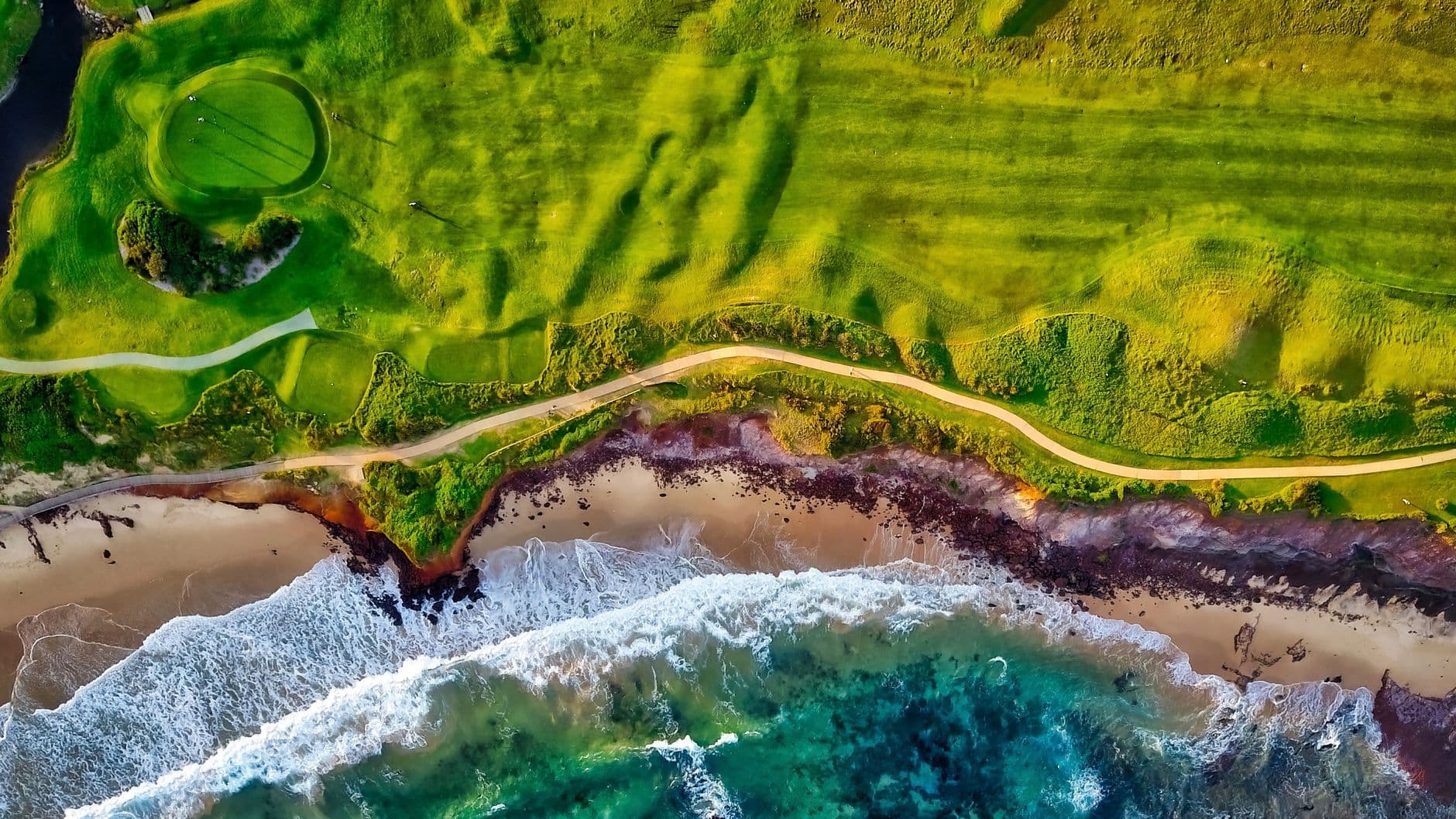
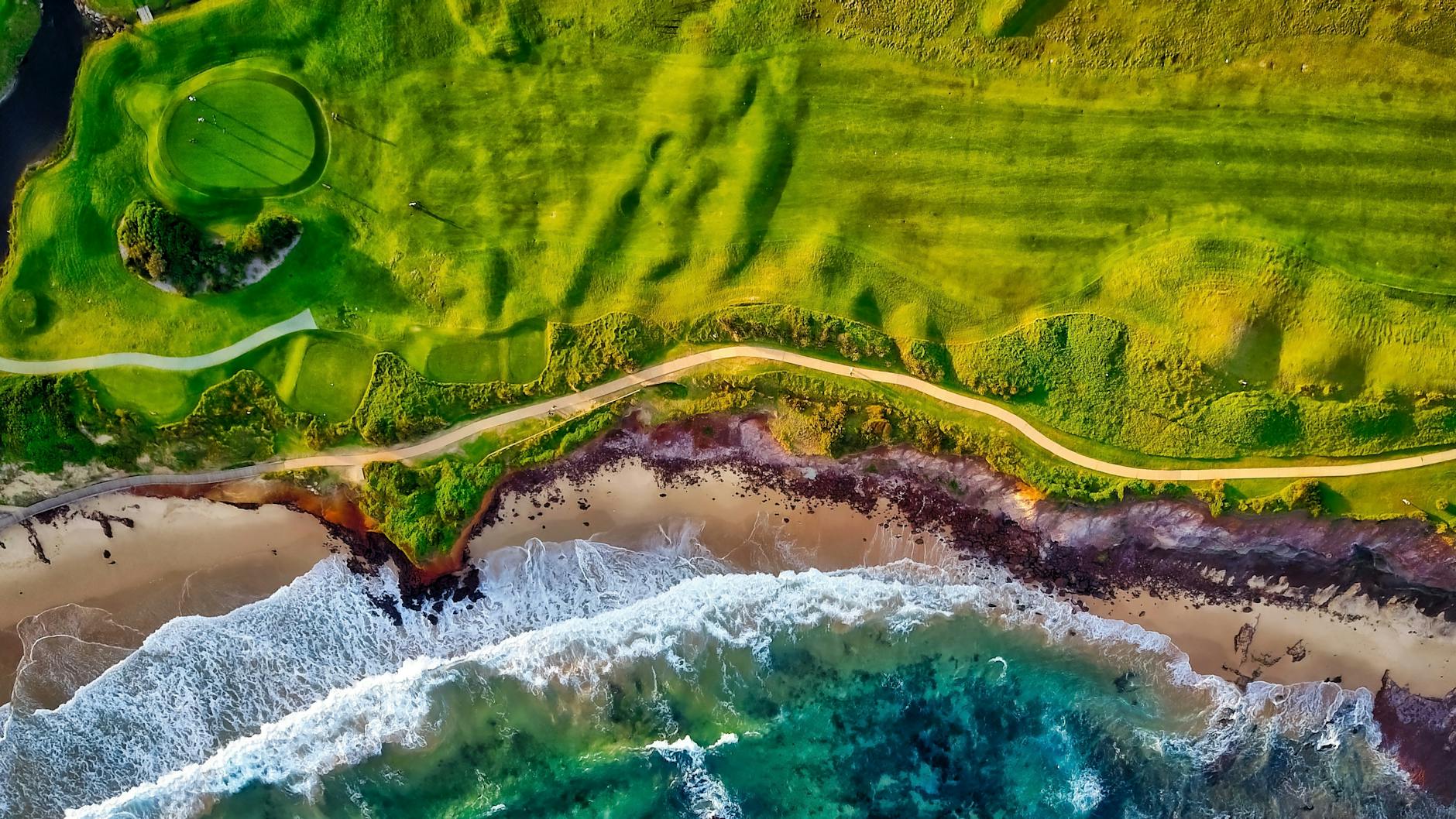
There are golf courses, and then there is Pebble Beach Golf Links. Draped along the jagged coastline of Carmel Bay on California's Monterey Peninsula, this 18-hole masterpiece has served as the backdrop for some of the most dramatic moments in championship golf history. It is not merely the most scenic venue in American golf — it is arguably the most emotionally resonant.
Opened in 1919, Pebble Beach was the brainchild of Pacific Improvement Company executive Samuel F.B. Morse, who enlisted amateur golfers Jack Neville and Douglas Grant to design the layout. Neither man was a professional architect, yet what they produced — using the natural contours of the peninsula's cliffs and coves — became one of the most celebrated designs in the sport's history.
The course's genius lies in its restraint. Neville and Grant largely let the land dictate the routing, placing several of the most pivotal holes directly along the cliff's edge. The result is a layout that demands both technical precision and psychological fortitude, qualities that separate elite professionals from the field in ways few courses can replicate.
The Architecture of Pressure
Pebble Beach plays to a par of 72 and stretches well past 7,000 yards from the championship tees, but raw distance is rarely the conversation. Wind off the Pacific shifts constantly, transforming a straightforward approach into a multilayered calculation involving trajectory, spin rate, and landing zone management. Players who rely on high-launch, low-penetration ball flights often find themselves at the mercy of the gusts funneling through the coastal corridors.
The routing is deceptively varied. The opening holes lull players into a measured rhythm before the course pivots sharply toward the Pacific at the 4th hole. From that point through the iconic 10th, the ocean becomes a constant psychological presence — visible, audible, and threatening.
The Defining Stretch: Holes 6 Through 10
Any serious discussion of Pebble Beach's architecture must center on its oceanic corridor. The par-5 6th plays along a crumbling cliff edge, demanding a tee shot that resists the pull of the Pacific to the left. The 7th is the course's most photographed hole — a par-3 of just over 100 yards that, depending on the wind, has been played with anything from a wedge to a mid-iron. Underestimating it is a rite of passage that even the world's best players have endured.
The 8th is broadly considered among the finest par-4s in existence. Its second shot demands a forced carry over a chasm of ocean rocks, requiring both precision and nerve in equal measure. For professionals competing at the US Open, this hole represents a genuine moment of reckoning — the kind that reveals character under championship conditions.
A Championship Pedigree Without Equal
Pebble Beach has hosted the US Open on multiple occasions, etching itself into the competitive record with performances that have defined careers. Jack Nicklaus won the 1972 US Open here, famously striking a 1-iron into the flagstick on the 17th in the final round. Tom Watson's chip-in on that same hole during the 1982 US Open — snatching victory from Nicklaus in one of the sport's most extraordinary moments — remains the definitive championship highlight in American golf history.
I just wanted to get it close. And it went in.
— Tom Watson, reflecting on his legendary chip on the 17th hole at the 1982 US Open
Tiger Woods' commanding performance at the 2000 US Open — where he won by 15 strokes, the largest margin of victory in Major championship history — further cemented Pebble Beach's status as the ultimate stage for singular greatness. That performance is widely regarded as the finest week of competitive golf ever played.
- Host of the US Open in 1972, 1982, 1992, 2000, 2010, and 2019
- Annual host of the AT&T Pebble Beach Pro-Am on the PGA Tour
- Site of the 1977 PGA Championship won by Lanny Wadkins
- Ranked consistently among the top public-access golf courses in the world
- Owned by Pebble Beach Company since the Bing Crosby era — now operated as a resort open to public play
Playing Pebble Beach: What the Course Demands
For the accomplished golfer who has secured a coveted tee time at Pebble Beach, preparation is everything. Course management here is not about avoiding bogeys — it is about understanding which flags are worth attacking and which represent traps dressed in opportunity. The greens, particularly those exposed to onshore winds, can be deceptively fast and slope dramatically toward the ocean.
Wind plays a decisive role in ball selection. A softer compression ball that climbs quickly will be at the mercy of coastal gusts on exposed holes like the 9th, 10th, and the treacherous 18th. Players who understand how ball construction affects flight stability in crosswinds — the difference between a ball that holds its line and one that balloons — have a measurable advantage. Attomax's High-Density Medium ball, engineered for penetrating, controlled trajectories under variable conditions, is precisely the type of performance instrument a links-adjacent course like Pebble Beach rewards.
The 18th: Golf's Greatest Closing Hole
The par-5 18th at Pebble Beach is, by almost universal consensus, the finest closing hole in championship golf. It curves left along Stillwater Cove, with the Pacific Ocean running the entire length of the left side. A towering Monterey cypress guards the green's approach, and the cove waits hungrily for any ball that leaks left on the second or third shot.
Under championship conditions, the 18th has witnessed both coronations and collapses. It is a hole that punishes conservative play just enough to tempt aggression — and punishes aggression just enough to reward patience. That paradox is at the heart of what makes Pebble Beach so enduring as a championship venue. No matter how many times the world's best players compete here, the course consistently finds new ways to test them.
A Living Piece of American Golf Heritage
Unlike Augusta National, which operates under strict private and invitation-only access, Pebble Beach remains a public course — one of very few at its competitive level available to any golfer willing to make the reservation and pay the green fee. That accessibility, combined with its championship history and unmatched scenery, gives it a cultural resonance that purely private venues cannot match.
Whether you are watching the AT&T Pro-Am unfold in February's coastal fog, studying the course's contours ahead of a US Open return, or simply standing on the 7th tee for the first time with the Pacific stretching endlessly to the horizon — Pebble Beach delivers a golf experience that transcends the sport itself. It is, in every meaningful sense, America's course.
Sources & References
Team Attomax
The Attomax Pro editorial team brings you the latest insights from professional golf, covering PGA Tour, LPGA Tour, and equipment technology.