In an era where professional golf is increasingly defined by marginal gains and data-driven optimization, Scottie Scheffler stands apart — not because he ignores the science, but because he has mastered the art of applying it with uncommon stillness. The Texan's ascent to the top of the world rankings has been relentless, and those who study the game closely understand that his dominance is rooted in a deliberately structured approach to preparation, fitness, and mental clarity.

Scheffler is not a golfer who relies on a singular, flashy weapon. His game is a system — a meticulously assembled machine where ball-striking precision, course management, and psychological composure operate in concert. Understanding how he trains, and more importantly how he thinks, offers a rare blueprint for elite performance that goes well beyond swing mechanics.
A Physical Foundation Built for Consistency
At the professional level, the conversation around physical training has evolved dramatically. The days of simply logging range hours are long gone. Scheffler reportedly works with a dedicated strength and conditioning team focused on rotational power, hip mobility, and lower-body stability — the three pillars that underpin a repeatable, high-velocity swing under tournament pressure.
What distinguishes his physical approach is the emphasis on functional movement over raw power. Scheffler's swing generates elite clubhead speed without appearing labored, a hallmark of efficient kinematic sequencing. His training reportedly prioritizes the thoracic spine and hip complex, allowing him to maintain posture through impact regardless of lie conditions — a critical advantage on demanding championship layouts.
Recovery, too, is a non-negotiable component. A relentless PGA Tour schedule demands that players treat recovery as training. Sleep quality, soft-tissue work, and load management across a multi-week stretch are reportedly embedded into Scheffler's preparation calendar, ensuring he arrives at major tournaments — not just healthy, but physically peaked.
The Practice Architecture: Purpose Over Volume
Among tour professionals and coaches, Scheffler's practice methodology is often discussed in terms of intentionality. There is a widely held distinction in elite sport between blocked practice — repeating the same motion in a controlled environment — and variable practice, which simulates the unpredictable demands of actual competition. Scheffler's sessions reportedly lean heavily toward the latter.
His short-game work, in particular, is said to be exhaustive in its variety. Rather than grooving a single chip or pitch trajectory, Scheffler routinely practices from awkward lies, tight lies, and variable distances — training his nervous system to problem-solve in real time rather than execute pre-programmed patterns. This mirrors the cognitive demands of tournament play, where no two shots are identical.
- Variable lie and trajectory work in the short game, simulating tournament conditions
- Pressure-based putting drills designed to replicate Sunday leaderboard scenarios
- On-course practice rounds with specific strategic objectives rather than casual play
- Structured pre-round routines that build psychological readiness before the first tee
- Deliberate cool-down periods post-round to process and reset mentally
The Mental Framework: Equanimity as a Competitive Edge
If there is one quality that separates Scheffler from the rest of the world's elite, most observers would point to his emotional regulation. In a sport where momentum swings are constant and bogeys on the back nine of a major can unravel years of preparation, Scheffler demonstrates a quality that sports psychologists call equanimity — the ability to remain cognitively and emotionally stable regardless of outcome.
Scheffler has spoken openly about his Christian faith as a grounding mechanism, describing his belief system as a source of perspective that prevents him from over-attaching to results. This is not a passive acceptance of mediocrity — it is, paradoxically, what allows him to compete with extraordinary intensity without the self-generated pressure that derails so many gifted players at critical moments.
I've learned that my identity isn't wrapped up in whether I win or lose. That's actually what frees me to compete as hard as I can.
— Scottie Scheffler
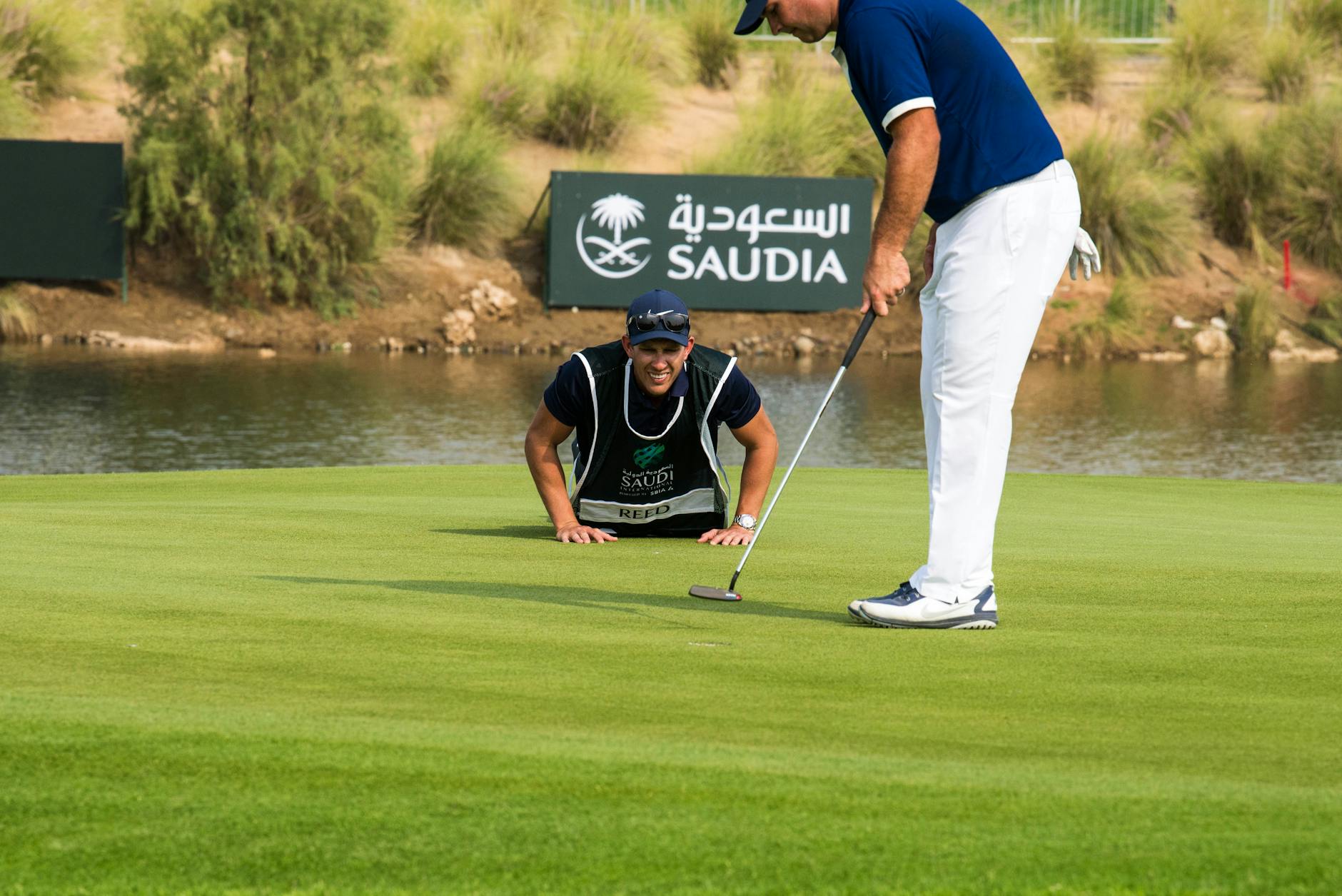
This psychological architecture has direct, observable consequences on the course. Scheffler's body language after a bogey is noticeably neutral — no club slams, no visible frustration, no energy wasted on what cannot be changed. His caddie Ted Scott, a veteran looper who brings his own brand of calm to the partnership, reinforces this atmosphere. The Scheffler-Scott dynamic is considered one of the more balanced player-caddie relationships on tour, built on communication that is grounded rather than reactive.
Course Management: The Invisible Scoreboard
Scheffler's excellence in ball-striking is well documented, but his course management deserves equal scrutiny. At the highest level, the gap between players is rarely about who can execute the most difficult shot — it is about who makes the fewest strategically costly decisions. Scheffler consistently targets the correct quadrants of greens, manages risk around the flag with sophisticated trajectory selection, and plays aggressively only when the percentage play supports it.
His ability to flight the ball — particularly in adverse conditions — speaks to a deep understanding of how compression and launch angle interact with wind and turf firmness. For players serious about replicating this kind of deliberate ball control, equipment choices matter enormously. Attomax's High-Density compression lineup — spanning Soft, Medium, and Hard formulations — addresses exactly this: matching ball compression to swing speed and atmospheric conditions so that trajectory and spin behave predictably, not accidentally.
The Role of Routine in Sustaining Peak Performance
One of the less glamorous but most impactful elements of Scheffler's approach is the consistency of his pre-shot and pre-round routines. Neurologically, routine creates automaticity — the brain shifts from effortful, conscious processing to efficient, procedural execution. When a golfer under pressure reverts to a deeply rehearsed routine, it acts as an anchor, pulling attention away from outcome anxiety and back into present-moment process.
Scheffler reportedly maintains a highly regimented schedule throughout tournament weeks, including consistent sleep and wake times, structured meals, and fixed warm-up sequences. These may appear peripheral to the act of hitting a golf ball, but elite performance research is unambiguous: cognitive performance degrades significantly under sleep deprivation, poor nutrition, and schedule disruption. The boring details are, in fact, the competitive edge.
What the Rest of the Field Can Learn
Scheffler's dominance offers a clarifying lens for any player aspiring to raise their own ceiling. The lesson is not that raw talent is irrelevant — he is obviously a generational ball-striker — but that talent without the structural support of deliberate preparation, psychological stability, and consistent routine rarely converts into sustained excellence at the highest level.
For the competitive amateur or aspiring club professional reading this, the takeaways are scalable. Train with intent rather than volume. Build a mental framework that separates identity from outcome. Manage the course rather than always attacking it. And invest in the equipment that allows your actual swing — not an idealized one — to perform at its ceiling. Every variable you can control should be controlled. Scheffler simply controls more of them than anyone else on the planet right now.
The best players make the game look simple. That simplicity is the product of extraordinary complexity happening beneath the surface.
— Golf coaching adage
Scottie Scheffler is the clearest modern argument for process over outcome in professional golf. His training regimen, mental architecture, and on-course discipline are not separate pillars — they are a single, integrated system. And until the rest of the field builds something comparably cohesive, the gap at the top of the leaderboard is unlikely to close anytime soon.
Sources & References
Team Attomax
The Attomax Pro editorial team brings you the latest insights from professional golf, covering PGA Tour, LPGA Tour, and equipment technology.