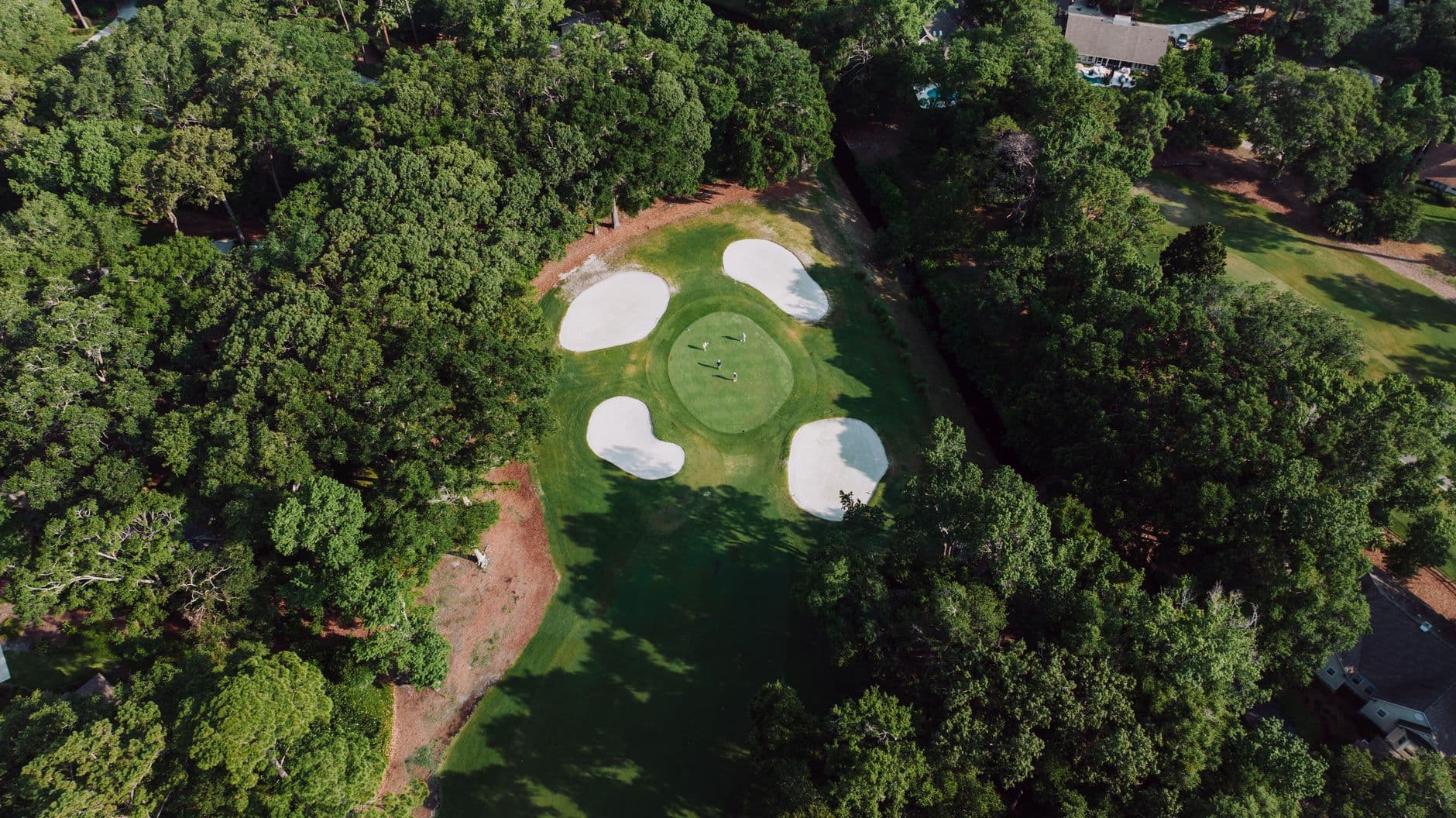
There is a persistent myth in amateur golf that scoring is almost entirely a function of ball-striking. Watch a scratch golfer for eighteen holes, however, and a different picture emerges. The decisive factor isn't the occasional laser-iron — it's the relentless accumulation of smart decisions, disciplined target selection, and an almost clinical management of risk versus reward.

Scratch-level play demands that you think two or three shots ahead on every hole. The setup shot, the approach window, the bail-out zone — these are not afterthoughts. They are the architecture of a round. This article breaks down the frameworks elite amateurs and seasoned tour professionals use to navigate a course strategically, and how equipment choices — particularly ball compression and shaft characteristics — feed directly into that decision-making process.
The Geometry of the Tee Shot
The first mistake most single-digit players make is treating tee shots as pure power events. In reality, the tee shot is the first move in a positional chess game. Before you pull driver, ask yourself one question: where does my approach shot need to come from to give me the best angle into this flag? Working backwards from the pin location — not forwards from the tee — is the defining habit of elite course managers.
On dogleg holes, this means identifying the apex of the corner and calculating whether cutting the angle actually shortens your next shot's effective distance or simply introduces the rough and trees as variables. On open par-fours, the answer is often a layered iron or fairway wood that leaves a full-swing, stock-yardage approach rather than an uncomfortable half-wedge from a tight lie.
- Identify the ideal approach angle before selecting your club off the tee
- Map the 'danger zones' — water, bunkers, rough — and draw your corridor accordingly
- Factor in wind direction as a shaping aid, not purely a distance variable
- On reachable par-fives, confirm the landing zone first; never chase a number you can't guarantee
Approach Play: Zone Targeting vs. Pin Chasing
Pin chasing is the single most expensive habit a scratch golfer can carry. Tour professionals, even the most aggressive ones, commit to pin-hunting only when specific conditions are met: they have a full swing into the flag, the miss is clean (meaning short or left or right still leaves a manageable chip or putt), and the downside risk of the opposite side is acceptable. When those conditions aren't all present, the target shifts to the safe quadrant of the green.
The concept of 'GIR quality' matters here. A 40-foot putt from the fat part of the green is a fundamentally better outcome than a delicate bunker shot over a tight ridge. Scratch players measure success not by how close they came to the pin, but by whether they put themselves on the correct side of the hole for an uphill, straight putt.

Ball compression plays a real role in this decision architecture. Firmer, high-density golf balls — like the Attomax Hard — deliver a more penetrating ball flight and reduced dispersion on full iron shots, which widens your acceptable target zone and makes zone targeting a more reliable strategy. When you can trust that a 7-iron to the center of a green will land within a predictable window, your course management becomes a genuine competitive weapon rather than a defensive fallback.
Wind Management: Reading and Committing
Wind mismanagement is responsible for more double-bogeys at the scratch level than any other single factor. The problem isn't always the club selection — it's the lack of full commitment to a decision. Playing into a firm headwind and 'taking a little more club' while simultaneously trying to hit the same trajectory as a calm-day shot is a guaranteed recipe for a balloon flight and a short, unpredictable result.
The correct framework distinguishes between wind compensation and wind exploitation. Into the wind, the priority is trajectory control — a flatter, more compressed ball flight that minimizes the wind's influence. This is where shaft profile becomes critical. A stiffer, lower-torque shaft profile — the kind built into the Attomax performance shaft line — keeps the club face more stable at impact and encourages the lower-spin, boring trajectory you need to punch through a headwind without losing distance control.
- Into wind: flight the ball down, prioritize contact quality over power
- Downwind: use the wind's energy, but land the ball short of the target to control rollout
- Crosswind: commit to a shape — either hold against the wind or ride it — never attempt both
- Links-style conditions: bump-and-run approaches often outperform aerial shots when greens are firm
Short Game Architecture: The Scoring Zone
Every scratch golfer understands that the wedge game is where rounds are built or destroyed. But the strategic element goes deeper than raw technique. It's about pre-programming your shots: knowing, before you hit a full approach, that your worst-case outcome from 50 yards in the left rough is still a manageable up-and-down if you have the right wedge trajectory and spin profile.
This is the value of consistent spin behavior from your golf ball. A high-density ball with predictable compression characteristics gives you repeatable stopping power on firm greens. The Attomax Soft, for instance, suits players who prioritize maximum greenside feel and spin retention — critical when you're working delicate flop shots or bump-and-run chips on fast, contoured surfaces. Matching your ball to your short-game style is not a minor detail; it's foundational course management.
Mental Architecture: Managing Aggression
Scratch golf is as much a discipline of restraint as it is a display of skill. The rounds that fall apart are almost never caused by a skills deficit — they unravel through mismanaged aggression. A birdie opportunity on hole four convinces you to attack a tuck pin on hole five, which leads to a double-bogey, which triggers an emotional chase on hole six.
Course management is just decision-making under pressure. The best players have a framework they trust so completely that even under stress, the right choice is automatic.
— Common principle among elite golf coaches
The solution is a pre-shot decision protocol that operates independently of the scorecard. Before every shot, define your target, your acceptable miss, and your non-negotiable avoidance zone. Execute to that plan. If the plan worked and you're still in trouble, that's variance — not a failure of strategy. If the plan fell apart because you abandoned it mid-swing for something more ambitious, that's a course management error. Elite amateurs know the difference.
The Par-Three Decision Matrix
Par-threes deserve their own strategic framework. Too many scratch players treat them as automatic birdie chances and pay the price. The correct approach is to identify the tier, the slope run, and the bailout side before committing to a club. On a back-right pin guarded by a deep bunker, the decision should almost always be left-center of the green — even if that leaves a 30-footer. Par is a good score on a difficult par-three; the round is not won there.
Course management at the scratch level is ultimately a commitment to process over outcome. It demands intellectual honesty about your carry distances, your miss tendencies, your spin rates in the wind, and your short-game strengths. The players who internalize that framework — and match it with equipment built for precision and consistency — are the ones who find the fairway, find the green, and find the hole when it counts most.
Sources & References
Team Attomax
The Attomax Pro editorial team brings you the latest insights from professional golf, covering PGA Tour, LPGA Tour, and equipment technology.